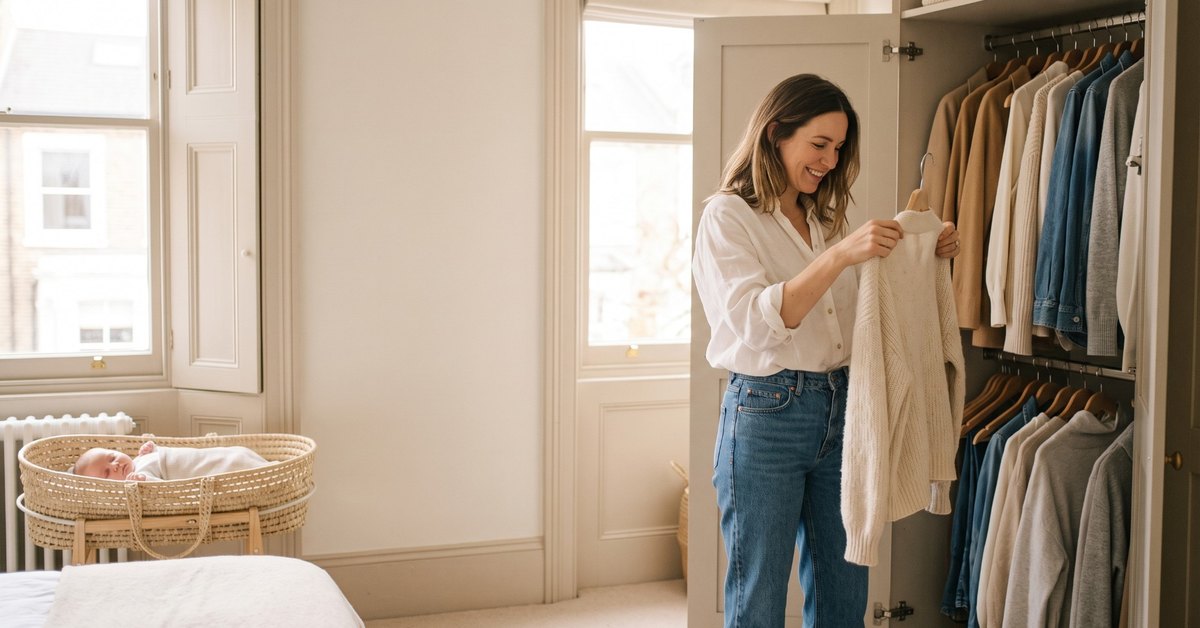
A few months after having a baby, a lot of women tell me the same thing: "I open my wardrobe and I just don't know what to wear any more." The old favourites don't sit the way they used to, the things that do fit feel shapeless, and getting dressed has become one more decision on a day already full of them.
If that sounds familiar, you are in very good company. Your body has changed, your days have changed, and your clothes haven't caught up yet. That isn't a failing. It's simply a wardrobe that was built for a different life.
So here is how I would approach what to wear after having a baby, the same way I would if we were working on it together: gently, practically, and for the life you are living right now.
WHY NOTHING FEELS RIGHT (AND WHY THAT'S NORMAL)
It's easy to blame your body when nothing works, but very often that's only half of the story.
Yes, your shape may be different: a fuller bust if you're feeding, a different line through the middle, hips that sit differently. But your lifestyle has changed just as much. You might be on the floor at baby class, walking for an hour with the pushchair, feeding at odd hours, and doing all of it on very little sleep.
Clothes that worked for an office, an evening out or a slower weekend don't always work for that. So when nothing feels right, it isn't only that things don't fit. It's that they don't fit the day you're having.
Once you see it that way, the question changes from "what's wrong with me?" to "what does my day actually need?" And that question has good answers.
DRESS THE BODY YOU HAVE NOW
This is the most important thing I'll say in this whole post: dress the body you have today.
Not the one you had before, and not one you feel you ought to have by a certain date. Clothes that pinch, gape or need hitching up all day are a constant small reminder that something isn't right, and you deserve better than that.
A few things I look for with mums:
- Waistbands that sit comfortably, whether that's a smooth high waist, an elasticated back or a drawstring. Sit down in them before you buy.
- Tops that skim rather than cling. A little ease through the middle looks more polished than something stretched tight or something three sizes too big.
- Shoulders that fit. If a jacket or a shirt fits at the shoulder, it looks deliberate, even worn open.
- Ignoring the size label. It's a number, and it changes from shop to shop anyway. How you feel in it is what counts.
COMFORT THAT STILL LOOKS PUT TOGETHER
Comfort is not optional with a baby. You'll be lifting, bending, carrying and sitting on the floor. But comfortable doesn't have to mean the same grey joggers every day (unless you love them, in which case wear them with a good jacket).
The secret is comfort with a little structure:
- Pull-on wide-leg trousers in a fabric that looks like tailoring
- Straight or wide-leg jeans with some stretch
- A long, soft cardigan or an unstructured blazer as a third layer
- A jersey midi dress you can throw on with trainers
That third layer does a lot of work. A T-shirt and jeans on their own can feel like "I didn't try". Add a cardigan, a trench or a jacket and it suddenly looks like an outfit, with no extra effort.
FEEDING-FRIENDLY PIECES THAT DON'T LOOK LIKE FEEDING CLOTHES
If you're breastfeeding or expressing, your tops have a practical job to do. You don't need a separate wardrobe of special clothes for this: plenty of ordinary pieces work beautifully.
- Button-front shirts and blouses, in soft cotton or a drapey viscose
- Wrap tops and wrap dresses, which open easily and flatter a changing shape
- Loose knits and jumpers you can lift, layered over a stretchy vest
- Separates rather than dresses, so only your top half needs to be accessible
- A long cardigan or a big scarf, if you like a little extra cover when you're out
Look for pieces you'd want to wear anyway. That way they keep earning their place long after the feeding days are over.
FABRICS THAT SURVIVE REAL LIFE
With a baby, everything gets washed. Often. So fabric matters more than it ever did.
Look for:
- Cotton jersey and cotton with a little stretch
- Ponte, which holds its shape and hardly creases
- Viscose blends that drape softly and wash well
- Fine knits that can go in the machine on a gentle wash
Sounds like you? Wardrobe Edit could help.
Think twice about:
- Anything dry-clean only
- Silk and pale linen for everyday wear
- Very thin jersey that shows every mark and loses its shape after a few washes
Small prints and mid-tones are kinder than plain white or plain black, which both show everything. A navy stripe, a soft khaki or a small floral will hide the odd mark you only notice once you're out of the house.
SHOES FOR PUSHCHAIR DAYS
You'll probably walk more now than you have in years. Your shoes need to keep up.
My favourites for pushchair days are clean leather trainers, loafers with a cushioned sole, flat ankle boots and, in autumn and winter, flat knee-high boots. All of them work with jeans, wide-leg trousers and midi dresses, so one pair covers almost every outfit.
Add a cross-body bag big enough for your keys, phone and wipes, and your hands stay free for the pushchair, the baby or the coffee.
COLOURS THAT FLATTER WHEN YOU'RE TIRED
When sleep is short, colour near your face makes a real difference. Black can feel safe, but it can also drain you on a tired day.
Try keeping your bottoms in an easy neutral (navy, denim, camel, khaki or grey) and choosing tops, knits and scarves in a colour that makes you look awake. For some women that's a soft pink or coral, for others a rich blue, a warm green or a creamy ivory. If you're not sure which suit you, that's one of the first things I look at with clients.
And keep the whole palette small. When everything goes with everything, getting dressed half asleep becomes much easier.
AN 11-PIECE AFTER-BABY CAPSULE
You don't need a whole new wardrobe. Here's a small capsule to start from, and you may already own some of it:
- Straight or wide-leg jeans with a little stretch
- Pull-on wide-leg trousers in a smart fabric
- A button-front shirt in soft cotton or viscose
- A wrap top
- Two good-quality T-shirts or long-sleeve tops in colours you love
- A soft jumper or fine knit
- A long cardigan or an unstructured blazer
- A jersey or wrap midi dress
- Clean leather trainers or comfortable flat boots
- A cross-body bag
The two bottoms and the four tops (the shirt, the wrap top and the two T-shirts) already make eight everyday outfits, and the dress makes nine, before you change the knit, the layer or the shoes. That's enough for most weeks, and every piece goes with the others.
THE FIVE-MINUTE OUTFIT FORMULA
On the busiest mornings, you need a formula, not a decision. This is the one I give mums:
Comfortable bottoms + an easy top + a third layer + comfortable shoes + one small detail.
For example: wide-leg trousers, a striped T-shirt, a long cardigan, white trainers and gold hoops. Or jeans, a wrap top, a trench, ankle boots and a scarf.
The small detail is the part that makes it feel like you: earrings, a lipstick, a belt, a favourite scarf. It takes seconds, and it's often the thing that makes you feel like yourself again. For more quick outfit ideas once you're settled into a routine, my post on styling tips for busy mums has plenty.
WHEN TO SHOP (AND HOW MUCH TO BUY)
Many women wait to buy anything until their body has "settled". I understand why, but it can mean months of living in clothes that make you feel low.
You don't need to wait, but you do need to buy wisely. Choose a few pieces that you'll wear for months and that can evolve with you as your body and your routine settle: forgiving cuts, stretch fabrics and adjustable waists. Wrap shapes, drawstrings and elasticated backs all move with you.
What I'd steer you away from is a pile of cheap "just for now" clothes. They rarely make you feel good, they rarely last, and they all end up at the back of the wardrobe.
So start small. Look at what you already own, keep what works today, put away the things you love but can't wear yet (rather than looking at them every morning), and fill only the gaps. Three or four well-chosen pieces can change how every day feels.
Going back to work soon? I've written a separate guide on what to wear going back to work after maternity leave.
COMMON QUESTIONS ABOUT WHAT TO WEAR AFTER HAVING A BABY
What should I wear after having a baby when nothing fits?
Start with comfortable bottoms that fit you now, such as pull-on wide-leg trousers or stretch jeans, then add a soft top and a third layer like a long cardigan. Buy for the body you have today, not the one you had before.
Should I wait until my body settles before buying new clothes?
No. Buy a few flexible pieces now, in forgiving cuts and stretch fabrics, so they keep working for months as your body and your routine change. Avoid buying lots of cheap "for now" clothes.
What can I wear for breastfeeding that doesn't look like feeding clothes?
Button-front shirts, wrap tops and wrap dresses, loose knits over a stretchy vest, and separates rather than dresses. They're easy to feed in and look like ordinary clothes.
Can a Personal Shopper & Stylist help mums after having a baby?
Yes. A Personal Shopper & Stylist can help you work out what suits your shape and your days now, and shop with you for a small number of pieces that all work together.
IF YOU'D LIKE HELP, LET'S DO IT TOGETHER
If you'd rather not work this out alone, this is exactly what my after-baby styling sessions are for. We shop together in person, in central London or Oxford, from high street to mid-range, for pieces that suit the body and the days you have now.
There are three set packages:
- Personal Shopping For Mums, £185: up to 3 hours of shopping together, including a telephone consultation, a video call and location research beforehand.
- Personal Shopping & 7 Outfit Planner, £275: the same, plus 7 outfits planned from what we buy.
- Personal Shopping & 14 Outfit Planner, £355: the same, plus 14 outfits planned from what we buy.
Not ready to shop yet? A wardrobe edit at home costs from £185, in North, West, South and Central London, Buckinghamshire, the Thames Valley and Oxford. We'll go through what you already own and see what still works for you now.
You haven't lost your style. It just needs to catch up with your new life. Find out how I can help you feel like yourself again.


