


How to Find Your Personal Style (Even If You Have No Idea Where to Start)
- Maria Pastor Paz
- Jun 15
- 5 min read

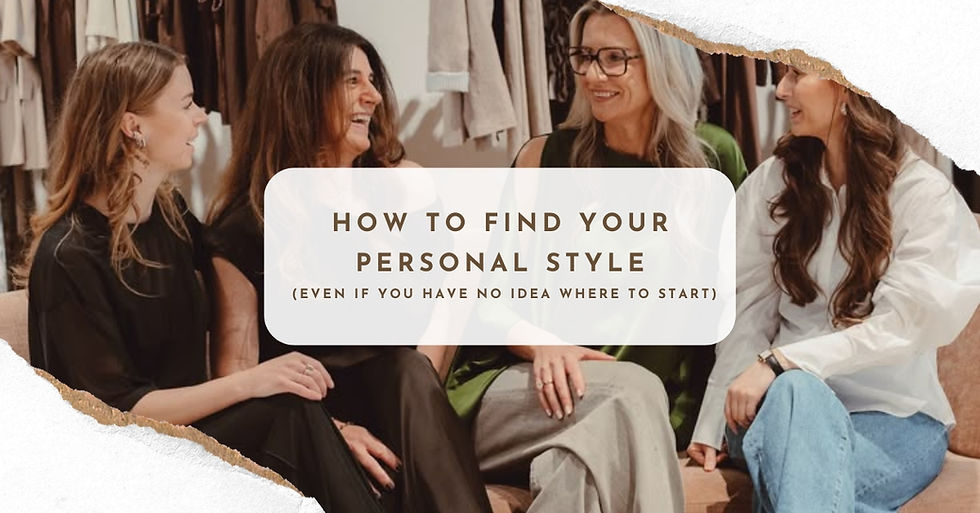
Here's something I say to almost every new client: most people don't actually have a personal style. What they have is a wardrobe full of things they bought on impulse, under pressure, or because something was on sale and it seemed like it might work. That's not a style. That's a collection. And I say that with nothing but kindness, because it is completely not your fault.
We live in a world that throws thousands of trends at us every single week. Fast fashion wants you confused, because confused people buy more. So if you've ever stood in front of a full wardrobe and felt like you had nothing to wear — I want you to know that's a very normal, very understandable feeling. It's also one you can move past.
Style isn't something you're born with. It's something you discover. And the good news is, the clues are already there. You just need to know where to look.
WHY MOST PEOPLE DO NOT HAVE A CLEAR PERSONAL STYLE
It's worth saying plainly: nobody teaches us this. There's no class at school on developing your fashion identity. Instead, we absorb messaging from magazines, social media, and well-meaning friends — most of it designed to make us feel like we're perpetually behind.
Add to that the pressure of dressing for different roles (professional, parent, social, casual) and it's no wonder style gets pushed to the bottom of the list. We end up making individual decisions — should I buy this top? — without ever stepping back to ask the bigger question: what do I actually want to look like?
That's where I come in. But before I even start pulling pieces together for a client, I ask them to sit with a few questions. The answers tell me everything I need to know.
THE REFLECTION QUESTION I USE WITH EVERY NEW CLIENT
These are the same questions I ask in my first consultation. Grab a notebook, take your time, and answer honestly. There are no wrong answers.
1. What do you want people to feel when they first meet you?
Not think — feel. Capable? Warm? Creative? Put-together? A little bit interesting? This is the emotional intention behind your style, and it's the most important starting point. If you want to feel approachable, that will look very different to wanting to feel authoritative. Neither is better. Both are valid. But you need to know which is yours.
2. What are you wearing on your best days?
Think about the last time you felt genuinely good in your clothes — not dressed up for a special occasion, but just a regular day when you looked in the mirror and thought yes. What were you wearing? How did the fabric feel? Were the colours soft or bold? Were you comfortable, or were you making an effort? Those moments contain real data about what works for you.
3. Who dresses in a way you admire — and what is it specifically about their style?
This might be a friend, someone you follow online, a fictional character, or a public figure. The key is to dig past "I like their style" and ask what exactly. Is it the colour palette? The way they mix relaxed and polished? The fact that they always look effortless? Identifying what you're drawn to is far more useful than just knowing you like it.
4. What do you never want to feel in your clothes?
This one is underrated. Knowing what you want to avoid is just as powerful as knowing what you want. Some women never want to feel fussy. Others can't stand feeling invisible. Some hate anything that needs constant adjusting. Your "nevers" are boundaries, and they're completely worth honouring.
LOOK FOR PATTERNS IN WHAT YOU ALREADY LOVE
Once you've answered those questions, I want you to do something practical: go to your wardrobe and pull out everything you genuinely love wearing. Not the things you keep meaning to wear, or the things you spent a lot of money on and feel guilty about. The things you actually reach for.
Lay them out (or hang them together) and look at them as a group.
What colours keep coming up? What fabrics? What shapes? Is there a particular feel — relaxed, structured, feminine, androgynous, layered? The pieces you love are your best evidence. They're telling you something about who you are and what makes you feel good. Listen to them.
USE PINTEREST AND STYLE FOLDERS AS RESEARCH TOOLS
Before Pinterest, I used to ask clients to tear pages out of magazines. The principle is the same: gather images of outfits, people, and aesthetics that make you feel something — without overthinking why.
When you've collected 30 or 40 images, step back and look at them together. Patterns emerge surprisingly quickly. You might notice you're drawn almost entirely to a particular colour palette. Or that nearly everything you've saved is relaxed and unstructured. Or that there's a consistent combination — like classic tailoring with something unexpected.
This isn't about copying an aesthetic. It's about gathering raw information about your own taste. Your style folder is essentially a personalised mood board, and it's one of the most useful tools I know.
THE DIFFERENCE BETWEEN TRENDS AND PERSONAL STYLE
Trends are what the industry decides is relevant right now. Personal style is what makes you feel like yourself, regardless of what's on the rails this month.
I'm not anti-trends — some of them are genuinely lovely, and there's nothing wrong with incorporating one if it works for you. But the question I always ask is: would I still want to wear this in three years? If the answer is probably not, it's a trend. If the answer is yes, it might be style.
Your style should outlast any season. It should be the thread that runs through your wardrobe, whether you're buying something new or getting dressed in something you've owned for years. When you know your style, shopping becomes much simpler — and much less expensive — because you stop buying things that don't fit the picture.
A GENTLE REMINDER: STYLE IS ALLOWED TO EVOLVE
I want to say this clearly, because I think people sometimes feel pressure to have a fixed identity when it comes to style: it's completely fine to change.
Your style at 25 will probably look different to your style at 45. A big life change — a new job, becoming a parent, moving somewhere new — can shift what feels right. That's not inconsistency. That's growth.
Discovering your style isn't about locking yourself into a box. It's about building a foundation — a clear sense of what you love, what you need, and what makes you feel like the best version of yourself — that you can build from and refine over time.
WANT A PROFESSIONAL EYE?
Finding your style is one of my favourite things to help with. There's something genuinely wonderful about watching someone try on an outfit that's perfectly them and seeing the shift in how they hold themselves.
If you'd like support with this, I offer Personal Styling sessions both in London and Oxford. We'll work through these questions together, look at what you already own, and I'll give you a clear picture of your personal style — along with practical guidance on how to build on it.


Comments