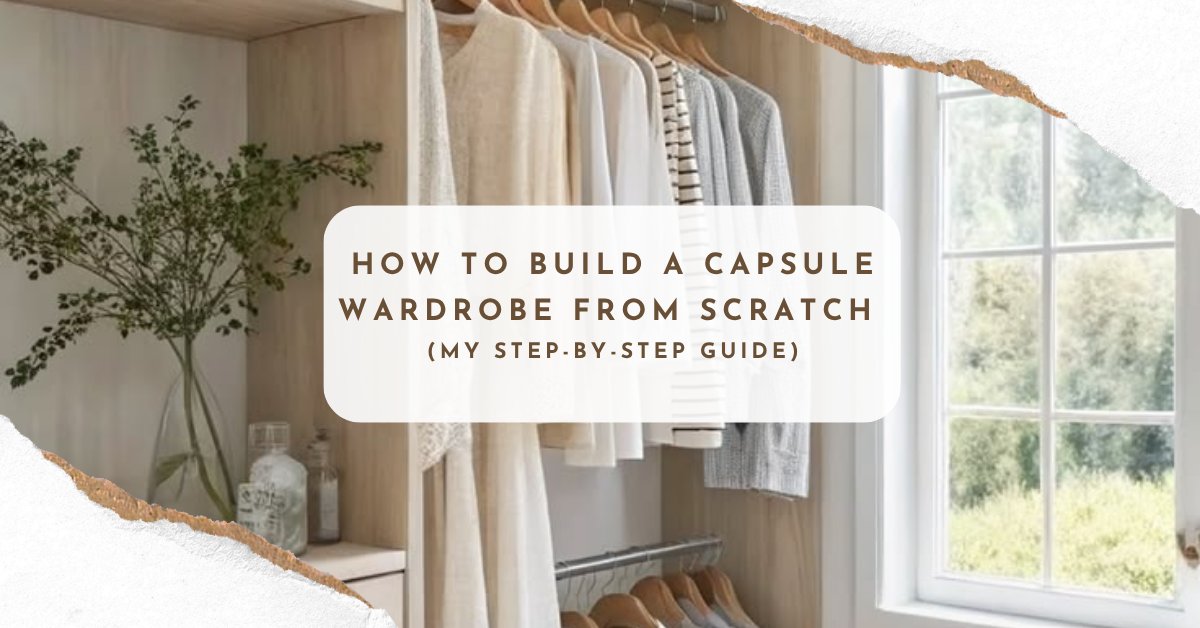
A few months ago, I sat with a client in her bedroom surrounded by two full wardrobes, an overstuffed chest of drawers, and a chair that had become a permanent dumping ground for clothes. She looked at me and said, "I have nothing to wear." She meant it sincerely — and honestly, I understood exactly what she was telling me. Everything she owned felt like it belonged to a different version of herself: the woman who went to the office every day, the one who used to go out more, the one who bought things in the sale because they were a bargain, not because she needed them. It's one of the most common things I hear from clients, and it's the reason I genuinely believe that knowing how to build a capsule wardrobe is one of the most transformative things you can do for your everyday life.
So let's talk about what that actually looks like — not in a vague, Pinterest-aesthetic way, but practically, step by step.
WHAT A CAPSULE WARDROBE ACTUALLY IS (AND ISN'T)
A capsule wardrobe is a small, intentional collection of clothes that all work together — where you can grab almost anything from the rail and put it with almost anything else. It's not about owning as few clothes as possible, or wearing the same neutral outfit every day. It's about owning the right things for your life, in colours and cuts that suit you, and nothing more.
It is not a minimalist aesthetic. It is not a prescribed list of 33 items. It is not beige. A capsule wardrobe looks different for everyone — a busy mum's will look nothing like a corporate professional's, and that's exactly as it should be.
STEP 1: AUDIT WHAT YOU ALREADY OWN
Before you buy a single thing, you need to know what you're working with. Pull everything out — yes, everything — and ask yourself three questions about each piece: Does it fit me right now? Do I actually wear it? Do I love it (or at least genuinely like it)?
Anything that fails all three tests goes. Be honest with yourself here. "I might wear it one day" is not the same as wearing it. "It was expensive" is not a reason to keep something that makes you feel frumpy every time you put it on.
What you're left with is your starting point. This is the foundation of your capsule wardrobe — and you'll often find you already own more of it than you thought.
STEP 2: UNDERSTAND YOUR REAL LIFESTYLE
This is the step most people skip, and it's arguably the most important. Think about what your days actually look like — not your best days, not your aspirational days, your actual ordinary days.
Sounds like you? Wardrobe Edit could help.
How many days a week are you in an office? How many are you running errands, doing the school run, working from home? When do you socialise, and what does that usually look like — a restaurant, a pub, a friend's kitchen? Do you exercise in clothes you'd buy anyway, or do you need a separate activewear drawer?
Your wardrobe needs to serve your real life, not the life you think you should have. I've helped clients who owned fourteen cocktail dresses and nothing to wear to a casual lunch. Your capsule wardrobe essentials should reflect what you actually do, not what you occasionally do.
STEP 3: CHOOSE A COLOUR PALETTE THAT WORKS FOR YOU
This is where a capsule wardrobe starts to feel cohesive rather than chaotic. You don't need to go full monochrome — but you do need a palette that works together so that most things in your wardrobe can be combined with most other things.
Start with two or three neutrals that suit your skin tone and that you genuinely like wearing. Then choose one or two accent colours that lift the palette. For many of my UK-based clients, that might look like navy, stone and white as the base, with a warm rust or deep green as the accent.
The key question to ask when choosing colours: does this work with everything else I already own, or does it only work with one specific thing? Versatility is the goal.
STEP 4: IDENTIFY THE CORE PIECES YOU'RE MISSING
Now you can look at what you have — in your chosen palette, for your actual lifestyle — and identify the gaps. These are your capsule wardrobe essentials: the things that would make everything else work better.
Common ones I see clients missing: a well-fitting pair of straight-leg trousers in a neutral, a blazer that actually fits their shoulders, a quality white shirt that doesn't go see-through, a flat shoe they can actually walk in all day. The specifics will be different for you, but the point is the same — these are the foundational pieces that make an outfit, not the impulse buys that hang unworn.
Write a list. Make it concrete. "A navy blazer in a relaxed fit, size 14" is a useful shopping list. "Maybe a jacket" is not.
STEP 5: SHOP INTENTIONALLY, NOT IMPULSIVELY
Armed with your list, you can shop — and this is where a capsule wardrobe approach pays off. You're not browsing to see what catches your eye. You're looking for specific things, and you know exactly what criteria they need to meet.
Quality really does beat quantity here. One well-made pair of trousers that fits you beautifully and lasts five years is better than three cheaper pairs that bag at the knees by January. I'm not saying you need to spend a fortune — there are fantastic pieces at every price point — but fabric, fit, and construction matter enormously. Check the weight of the fabric. Look at the stitching. Try it on and move around in it.
And before you buy anything that isn't on your list: ask yourself whether it genuinely works with three things you already own. If the answer is no, put it back.
ONE LAST THING
Building a capsule wardrobe isn't a one-afternoon project. It's an ongoing process of getting to know yourself — what you actually need, what makes you feel confident, and what suits the body and life you have right now, not the ones you used to have or hope to have.
The client I mentioned at the start? We edited her wardrobe down to what she genuinely loved. The last time I heard from her, she told me getting dressed had stopped feeling like a daily battle. That's exactly what this process is for.
If you'd love some help working through it, I offer Wardrobe Edit sessions in London, Oxford — where we do exactly this together, tailored completely to you. Feel free to get in touch and we can talk through what would work best for you.